
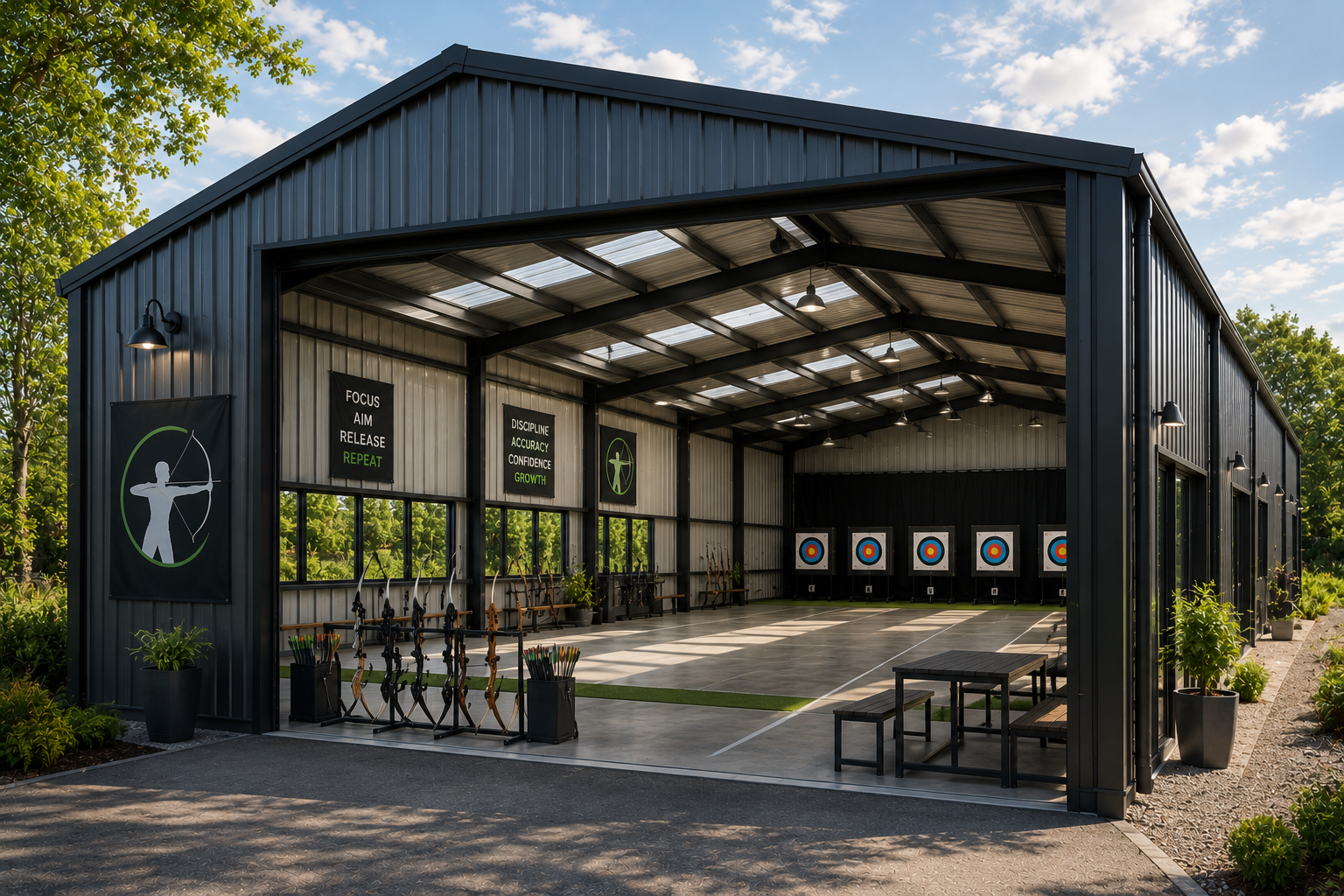
Archery is a discipline rooted in history yet continuously refined through modern sport and technology. Today’s archers train not only for recreation but for structured competition, school programs, collegiate leagues, and elite events. Precision, repetition, and focus define success in this sport, and those qualities depend heavily on the training environment. A poorly designed facility can disrupt concentration, compromise safety, and limit performance development. A thoughtfully constructed space, on the other hand, becomes a catalyst for growth, confidence, and competitive readiness.
Metal structures have become increasingly prominent in the development of specialized sports facilities, including archery ranges. Their structural strength, adaptability, and cost efficiency make them well-suited for both private clubs and large training complexes. Steel framing systems create wide open interiors that accommodate standardized shooting distances while supporting integrated lighting, ventilation, and safety features. As archery continues to expand in popularity across youth organizations and professional circuits, metal buildings offer a practical and forward-thinking solution for long-term facility planning.
Why Are Metal Structures Well Suited for Archery Training Facilities?
Metal buildings provide the structural capacity necessary to create expansive, column-free interiors. Clear span designs eliminate interior obstructions that could interfere with shooting lanes or create safety concerns. Archers rely on uninterrupted sightlines to maintain proper form and alignment, and steel framing makes this possible across wide distances.
Durability also sets metal apart from other construction materials. Steel resists moisture damage, insect infestation, and structural warping that can occur with wood framing. In climates with extreme heat, heavy rainfall, or strong winds, metal buildings maintain structural integrity with minimal deterioration. This resilience ensures that archery facilities remain reliable for years of consistent use.
How Do Clear Span Interiors Enhance Safety and Accuracy?
Clear span construction is particularly valuable in archery because it allows for standardized lane spacing. Facilities can be designed to match competition distances recommended by organizations such as World Archery, ensuring that athletes train under conditions similar to official events. Absence of interior columns reduces the risk of deflected arrows and eliminates visual distractions.
Coaches benefit from unobstructed views across the entire range. They can monitor form, release technique, and posture without moving around structural barriers. This visibility improves instruction quality and enhances safety oversight during group sessions.
What Safety Measures Should Be Integrated Into the Structure?
Safety planning begins with proper range orientation and reinforced backstop systems. Steel frames provide strong anchoring points for layered target curtains and impact-resistant panels. These systems prevent arrows from penetrating beyond designated zones.
Controlled access points are essential in any archery facility. Entry doors should be positioned away from shooting lanes to avoid accidental cross traffic. Observation areas must be separated by protective barriers or enclosed viewing sections. Metal structures accommodate reinforced partitions that maintain clear sightlines while preventing unauthorized entry into active shooting areas.
How Can Indoor Metal Facilities Provide Environmental Control?
Outdoor archery exposes athletes to wind drift, shifting sunlight, and sudden weather changes. Indoor metal facilities create stable training conditions that promote consistent skill development. Insulated wall systems reduce temperature fluctuations, while reflective roofing materials help manage solar heat gain.
Ventilation systems integrated into steel buildings maintain fresh air circulation without creating disruptive drafts. Climate control is particularly important in regions with high humidity or extreme temperatures. Consistent indoor conditions allow archers to focus entirely on technique rather than environmental variables.
How Does Lighting Influence Performance?
Lighting design directly affects target visibility and eye strain. Even illumination across shooting lanes ensures that targets appear consistent at every distance. Steel framing systems support suspended LED lighting arrays positioned to minimize glare and shadowing.
Natural light can complement artificial lighting when carefully managed. Translucent wall panels or clerestory windows allow daylight to enter without creating uneven brightness. Balanced lighting enhances depth perception and contributes to accurate aiming.
Why Is Acoustic Treatment Important in Metal Buildings?
Metal surfaces can amplify sound, creating echoes that disrupt concentration. Although archery is not a loud sport, acoustic clarity remains important for communication between coaches and athletes. Sound-absorbing panels installed along walls and ceilings reduce reverberation and create a focused training atmosphere.
Steel structures easily support acoustic materials without compromising stability. Improved sound control enhances the overall experience, especially during instructional sessions and competitive events where announcements must be clearly heard.
How Can Facilities Accommodate Different Skill Levels?
Archery facilities often serve beginners alongside experienced competitors. Flexible layouts allow for varied shooting distances within the same structure. Adjustable target systems enable coaches to modify lane lengths according to training objectives.
Separate instructional zones can be integrated into the building design. Beginners may practice at shorter distances while advanced archers train at full regulation ranges. This adaptability ensures that the facility supports long-term skill progression.
How Do Metal Structures Support Competition Standards?
Competitive events require precise measurements and consistent layouts. Steel buildings can be engineered to accommodate official lane spacing, target placement, and ceiling heights recommended for indoor tournaments. Facilities modeled after standards seen in events such as the Olympic Games project professionalism and readiness for sanctioned competitions.
Large open interiors allow for spectator seating, judging stations, and equipment storage. Clear organization of competition areas enhances event flow and athlete confidence.
What Foundation Considerations Are Necessary?
A stable foundation ensures level shooting surfaces and accurate distance measurement. Concrete slabs are commonly used in metal archery facilities due to their durability and ease of maintenance. Proper grading and drainage prevent water accumulation around the building perimeter.
Steel frames distribute structural loads evenly across the foundation. This balanced weight distribution reduces stress points and preserves long-term stability. Careful site preparation contributes significantly to facility longevity.
How Can Energy Efficiency Be Integrated Into the Design?
Energy efficiency reduces operational costs and supports environmental responsibility. Insulated metal panels provide thermal regulation, decreasing reliance on heating and cooling systems. High-efficiency HVAC units maintain consistent indoor climates.
Solar panel installations are compatible with many metal roofing systems. Structural strength supports the additional load of photovoltaic arrays, allowing facilities to generate renewable energy. Sustainable design choices enhance both financial and environmental outcomes.
How Do Maintenance Requirements Compare to Other Materials?
Metal buildings generally require less maintenance than wood or masonry structures. Protective coatings guard against corrosion, and routine inspections help identify minor issues before they escalate. Cleaning metal surfaces is straightforward and does not involve specialized treatments.
Interior systems such as lighting and ventilation should be inspected regularly to maintain performance. Overall, steel construction simplifies upkeep and reduces long-term repair expenses.
Can Spectator and Community Spaces Be Included?
Archery facilities often function as community gathering spaces. Metal structures can incorporate meeting rooms, administrative offices, and seating areas within the same footprint. Elevated viewing platforms provide safe observation without interfering with shooting lanes.
Hosting tournaments, workshops, and youth camps fosters community engagement. A well-designed metal building becomes more than a training space; it evolves into a center for education and collaboration.
How Does Technology Enhance Modern Archery Facilities?
Digital scoring systems and video analysis tools are increasingly common in competitive training environments. Steel frames support mounting equipment such as cameras, projection screens, and electronic scoreboards. Reliable wiring infrastructure can be integrated during construction.
Video playback allows athletes to evaluate posture, anchor point consistency, and release mechanics. Technological integration strengthens coaching effectiveness and accelerates skill refinement.
How Can Metal Facilities Adapt to Future Growth?
Archery programs may expand as interest increases. Metal structures are inherently modular, allowing additional bays or extensions to be added with minimal disruption. Planning for expansion during initial construction reduces future renovation costs.
Flexible interior layouts make it easier to reconfigure spaces as programming evolves. Storage areas, offices, or additional lanes can be incorporated without major structural modifications.
What Design Elements Improve Athlete Comfort?
Comfort influences concentration and endurance. Adequate ceiling height prevents a confined atmosphere and improves air circulation. Anti-glare finishes on interior walls reduce visual distraction.
Flooring materials should provide a stable footing while minimizing fatigue. Climate-controlled environments help athletes maintain focus during extended training sessions. Thoughtful design decisions contribute to sustained performance and satisfaction.
How Do Regional Climate Conditions Shape Structural Choices?
Climate determines insulation requirements, roof pitch, and ventilation strategies. Snow-prone regions require roofs engineered for additional load capacity. Hot climates benefit from reflective coatings and ventilation systems that reduce interior heat buildup.
Steel structures can be customized to address these conditions without sacrificing design flexibility. Regional adaptation ensures that facilities remain operational regardless of seasonal variations.
How Does Facility Layout Influence Workflow?
Efficient layout supports smooth movement between shooting lines, equipment storage, and administrative areas. Clearly defined pathways reduce congestion and enhance safety. Strategic placement of storage racks keeps bows, arrows, and protective gear organized.
Administrative offices near entrances allow staff to monitor access and manage scheduling. An organized layout improves operational efficiency and creates a professional atmosphere.
What Financial Advantages Do Metal Structures Offer?
Construction timelines for metal buildings are typically shorter than traditional methods. Prefabricated components accelerate assembly and reduce labor costs. Predictable material pricing simplifies budgeting and financial planning.
Long-term savings arise from durability and energy efficiency. Reduced maintenance requirements allow operators to allocate funds toward program development and equipment upgrades.
How Can Youth Development Programs Benefit?
Youth programs require safe, structured environments. Metal archery facilities provide enclosed spaces that shield young participants from external distractions. Controlled layouts enable instructors to maintain close supervision.
Dedicated beginner lanes encourage skill progression without intimidation. Reliable infrastructure builds confidence among parents and participants, strengthening community trust.
How Do Metal Structures Promote Long-Term Sustainability?
Sustainability extends beyond energy efficiency. Steel is recyclable and often contains recycled content, reducing environmental impact. Durable construction minimizes waste associated with frequent repairs or rebuilding.
Facilities designed with longevity in mind support consistent programming and community engagement. Sustainable planning ensures that the building remains an asset for decades.
Conclusion
Metal structures offer a comprehensive solution for archery training facilities that demand safety, adaptability, and long-term value. Clear span interiors create unobstructed shooting lanes aligned with standards recognized by organizations such as World Archery, while structural resilience protects athletes and equipment in diverse climates. Controlled lighting, acoustic treatment, and climate regulation enhance focus and performance, ensuring that training conditions remain consistent throughout the year.
Adaptable layouts accommodate youth instruction, competitive tournaments, and community events inspired by global showcases like the Olympic Games. Energy-efficient systems and durable materials reduce operational costs while supporting environmental responsibility. With thoughtful planning and strategic design, metal archery facilities become dynamic centers of athletic development, fostering precision, discipline, and community engagement for generations to come.